

From 1550 to today
Since its construction during the Wars of Religion, the chateau has stood the test of time. It was spared during the French Revolution and World War II. The various owners have made a few alterations over the years, but the interior and exterior layout remain faithful to the 16th-century chateau.
Here are the most significant dates of his history:
Before 1550
The oldest artefacts found on the site date back to Gallo-Roman times. During excavation work in 1832, coins of Hadrian and Nerva were found, as well as ancient sarcophagi. Historians believe these may come from a Gallo-Roman castrum (Mons Bazalha), and that a wooden dwelling once stood on the exact site of the castle. As no remains have been found, this hypothesis cannot be confirmed.
1550
Lord Charles d’Aydie began building the pleasure palace on the site of the Monbazillac manor house, which he inherited from his father. 32 years later, construction was completed and has not changed since.
A few words about the architecture:
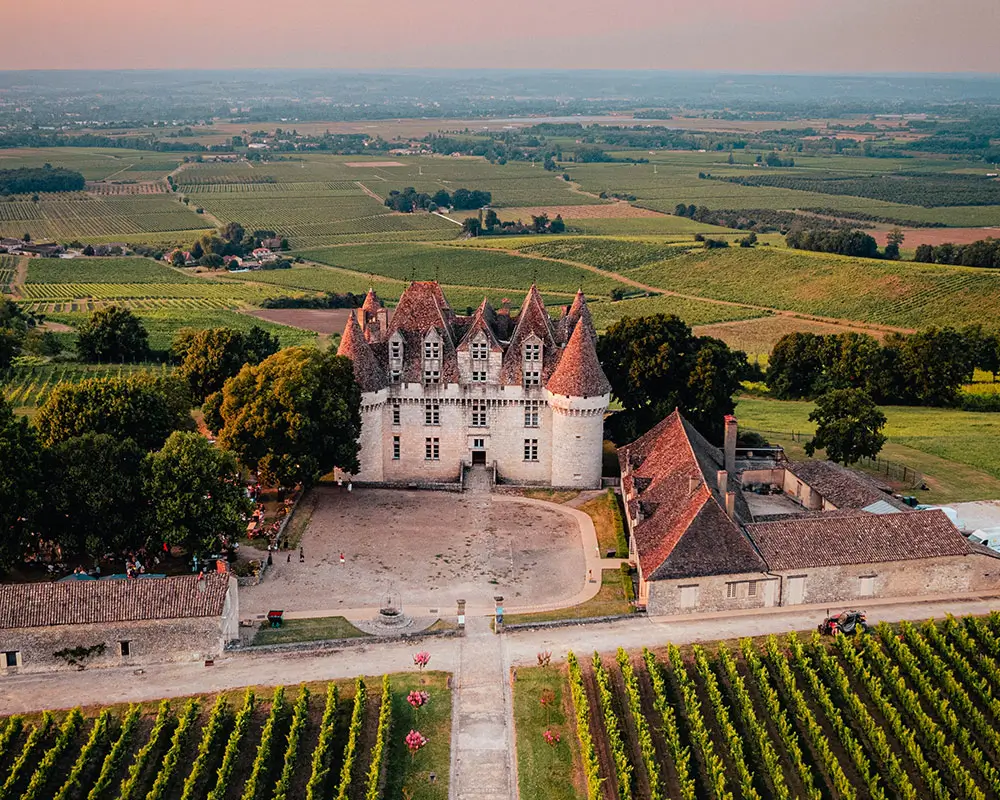
Château de Monbazillac is unique in that its architecture is typical of two major periods in history. From the Middle Ages, it retains its simple military lay-out, a rectangle flanked by four pepper-pot towers, one at each corner, with the military features of the time: sentry walk, dry moat, machicolations and embrasures. But Château de Monbazillac also draws inspiration from the Renaissance period, with its large mullioned windows and wide staircase, turning this jewel into a real home, a house with every comfort.
The castle is built from grey limestone and is surrounded by a dry moat, only one corner of which has water coming from a spring. A double arch stone bridge connects the only entrance, on the south side, to the main courtyard. This south façade is asymmetrical in appearance, as the entrance is offset to the right in relation to the building’s central axis, located where one of the four windows on the ground floor used to be. As for the doorway, a tall rectangle with simple mouldings, it is topped by a fanlight window and lintel decorated with a coat of arms, with decorative scrolls on either side.
A covered, crenellated and continuous sentry walk, supported by triple-redan machicolations, crowns the top of the façade and the towers, and continues around the building.
1562-1598: The Wars of Religion
Protestantism took hold rapidly in the Bergerac region.
During this troubled period of intense fighting and precarious peace, there were major clashes between Catholics and Protestants. Monbazillac has been an important Protestant stronghold ever since. In fact, the religion was even practised for years within the castle itself, out of sight and in total secrecy. The violence of the Wars of Religion came to the chateau’s gates when the Huguenots burnt down the village church (1563), but fortunately never reached the chateau itself.
1608
By 1600, the village of Monbazillac had grown so much that it became the jurisdiction of eight parishes. Eight years later, in 1608, the lordship of Monbazillac was made a viscounty by Henri IV, King of France.
1685
The revocation of the Edict of Nantes by Louis XIV forced the local Protestant population to emigrate (particularly to Germany and the Netherlands) to escape persecution. This tragedy for Protestant families in Périgord turned out to be a boon for the export of Monbazillac wines.
Despite constant changes in ownership between 1607 and 1960 and 353 years of tumultuous history, Château de Monbazillac still stands proudly on its promontory overlooking the Dordogne Valley.
1960
The Cave Coopérative bought the chateau for 400,000 new francs, the currency at the time. Unfortunately, the former owners left the entire building completely empty, but the winegrowers soon decided to share this heritage treasure by opening it to the public in 1961 and refurnishing it over the years.
1999
Unfortunately, the chateau’s roof was not spared by the storm of the century. Major work was undertaken to repair the damage.
2021
The chateau got a makeover. Over eight months, major works took place inside the chateau to ensure that visitors are welcomed in the very best conditions and enjoy an improved experience, with a new tour that’s even richer and more comprehensive, dynamic and immersive for the whole family!
NOW
The Cave Coopérative has around 40 winegrower and winemaker members, who are also co-owners of Château de Monbazillac. They are therefore the guardians of this historic monument. By opening the site to the public and making the tour ever more dynamic, the winemakers have chosen to share the heritage from past generations and their passion for their craft through the symbol of Monbazillac.
Protecting our heritage for future generations
As the site is privately owned, there is no public funding to help safeguard it. Since 1960, it has been the responsibility of the winemakers to preserve our shared heritage. By visiting Château de Monbazillac, you are playing an active part in preserving and developing this monument. For this, you have our warmest thanks. If you would like to go further in helping us maintain this jewel of Périgord heritage, you can become a Monbassadeur or make a donation !