

An exceptional terroir
The Monbazillac wine production area covers 2.300 hectares
Monbazillac is the largest region of dessert wines in the world. Out of the 8,000 hectares producing dessert wines in France (Sauternes, Jurançon, Coteaux du Layon, etc.), more than a quarter are dedicated to Monbazillac.
|
Chiffres 2025 |
Cave Coopérative de Monbazillac |
AOC Monbazillac |
|---|---|---|
|
Production area (in ha) |
950 |
2300 |
|
Number of bottles |
3 millions |
8 millions |
|
Number of producers |
50 |
120 |
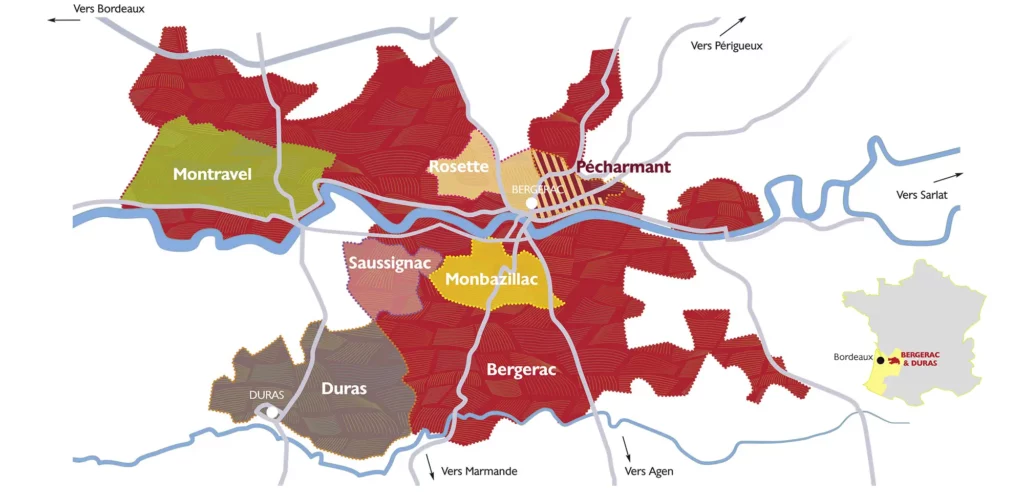
The Monbazillac wine region: the subtle blend of three essential factors
The terroir
The slopes rise between 40 and 180 m above sea level, from the Dordogne River to the promontory of
Château de Monbazillac The soils are predominantly clay-limestone. The terroir is made up of several grape varieties from which Monbazillac wine is made: Sauvignon Blanc, Sauvignon Gris, Semillon and Muscadelle. Semillon occupies 80% of the wine region. Monbazillac is therefore a blended wine.
The climate
Exposed to the north and close to the Dordogne River, the vines experience alternating cool nights and hot days, particularly in the autumn. The alternating warm and cold temperatures result in morning fog.
The noble fungus
These geographic and climate conditions favour the development of Botrytis cinerea. This fungus is the winemakers’ natural ally. It transforms the grapes with noble rot during the warm months of autumn. This is a natural process that occurs with temperature variations and fairly high humidity. Botrytis cinerea develops inside the grapes, concentrating the natural sugars and aromas by evaporating the water in the fruit. This extreme concentration is what produces a sweet dessert wine.
Three grape varieties showcasing the mystery of Monbazillac
Semillon
Semillon brings power and structure to wine blends, particularly when paired with Sauvignon, for which it serves as the primary partner in Monbazillac.
It is a golden yellow colour and offers a wide range of aromas of apricot confit, pineapple or mango. The grape variety develops complex spicy and honey notes.
Sauvignon Blanc
Sauvignon Blanc is the grape variety that winemakers mix with Semillon – the dominant grape. It offers freshness and fruity aromas.
Its light colour comes with hints of green. The grape variety develops herbaceous and fruity notes of citrus and rhubarb, paired with floral hints of elderflower and mineral touches. Its acidity on the palate provides a vibrancy that serves sweet wines well.
Muscadelle
In blends, Muscadelle provides floral notes of acacia and honeysuckle as well as fruity notes of peach and apricot, enhanced by a touch of spice. It is soft and smooth on the palate.
Be careful not to confuse sweet wine with dessert wine!
We’ll help you tell the difference – it’s all a question of sugar:
Monbazillac contains a minimum of 45 grams of sugar per litre after fermentation, which is obtained following late harvests with “tries successives” (multiple passes through the vineyard to select grapes with the right amount of noble rot).
If you have to remember just one thing, it’s that Monbazillac is a dessert wine, not merely a sweet wine, as it is even more concentrated.
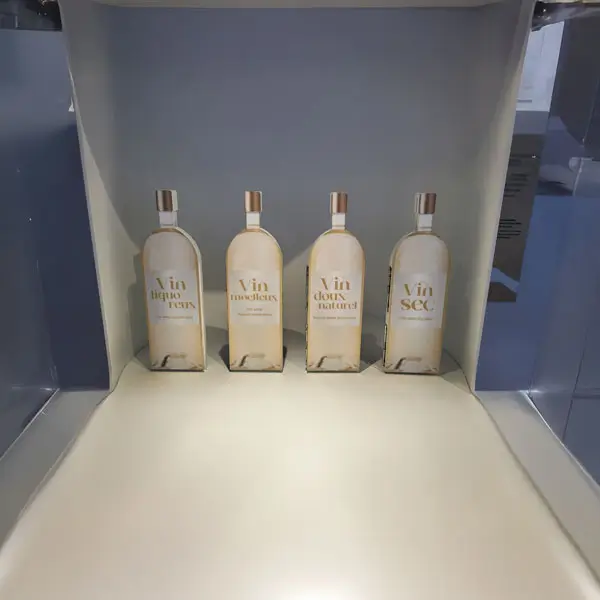
Between 0 and 10g
Dry or semi-dry wine
Between 10g and 45g
Sweet wine
More than 45g
Dessert wine
Do you really know the language of wine?
The exhibition will answer all of these questions, with the answers showcased in videos, photographs, infographics, illustrations and audio that will delight visitors on this interactive tour.
The most significant dates in the history of the vineyard
-56 BC to 4th century AD
The first traces of grapevines date back to Gallo-Roman times, long before the construction of Château de Monbazillac in 1550.
1080
Vineyards were cultivated by a Benedictine priory, i.e. a monastery, on “Mont-Bazailhac” land.
12e century
Legend has it that the monks of the monastery were busy with other tasks and neglected their vines, allowing noble rot to develop. Wishing not to lose the fruits of their harvest, they decided to make wine from the mouldy grapes. They discovered the unsuspected virtues of Botrytis cinerea, which gives grapes and wine a smooth, powerful flavour.
13e century
In 1254, the Duke of Aquitaine, who had become King of England under the name Henry II, decided to favour goods from Bergerac. The wine was sent down the Dordogne River and continued its journey, first to England, then to Holland.
14e century
In 1367, at the height of the Hundred Years’ War, the English agreed to protect Bergerac on condition that the consuls provided them with money, food and clothing, but also, and above all… wine! In 1376, the King of England granted Bergerac winemakers the royal privilege of supplying the Court of London
15e century
In the early 15th century, the bourgeois and inhabitants of Bergerac bought the Monbazillac vineyards. On 4 September 1495, regulations were amended to include this territory in the Bergerac Wine Region, providing certain privileges for selling and exporting these wines.
16e century
The city of Bordeaux imposed the use of smaller barrels for wine transiting through its port. Sales from Bergerac to England plummeted, as English customs duties were linked to the number of barrels. Holland gradually became the leading export destination for Monbazillac.
1685
The Wars of Religion and revocation of the Edict of Nantes led to the great families of the Huguenot bourgeoisie of Périgord emigrating to Holland, many of whom were winegrowers in Monbazillac. Relations between Bergerac and North Flanders flourished, thanks to the wine trade.
1738
With the expansion of trade to Holland, a veritable hierarchy was established in the quality of sweet wines. A first guarantee of origin appeared in the form of 32 “Dutch brands”. They were all located on the north side of Monbazillac and branded on the bottom of the barrels.
18e century
The aristocracy and bourgeoisie of Europe were enamoured with Monbazillac “Muscat”, a name derived from the Muscadelle grape variety. The King of Prussia, Frederick II, considered it his favourite wine.
1789
The French Revolution marked the end of a golden era for the Bergerac vineyards. With the departure of major landowners, the land was divided up and production capacity reduced. The inability to meet importers’ expectations meant that the region was gradually abandoned.
1885
The Phylloxera insect wreaked havoc in France. The Monbazillac vineyards were not spared. In 1885, they were completely destroyed. Using grafts onto disease-resistant American vines, the vines were replanted from 1895 onwards.
By 1920
A third of the wine region had been planted with vines once again
1936
After several court cases in the 1920s and 1930s over use of the name “Monbazillac”, the Decree of 15 May 1936 put an end to demarcation problems. The Monbazillac “Appellation d’Origine Contrôlée” (Controlled Designation of Origin, AOC) was created, one of the first in France. A set of specifications laid down the conditions under which the grapes must be grown and made into wine within the appellation, guaranteeing a high standard of quality.
1940
31 winegrowers joined forces to create the Cave, which becomes a cooperative in 1943.
1939-1945
Monbazillac winegrowers enjoyed unexpected prosperity. In wartime, France was cruelly short of sugar, and the shortage was made up for by unprecedented consumption of this wine, whose sweet, syrupy flavour was much sought-after.
1960
Château de Monbazillac came up for sale. The Cooperative Winery was already renting and farming the surrounding vineyards. The Board of Directors voted unanimously to buy the chateau, refusing to allow this monument to pass into foreign hands.
1978
The Queen Mother of England, Elizabeth Bowes-Lyon, visited Château de Monbazillac, where she enjoyed a private tour. At teatime, the English beverage was replaced by Monbazillac, a 1975 vintage.
1992
The specifications for the “Monbazillac” appellation were updated. The new version, drafted by the winemakers and approved by the government, imposes stricter regulations: the number of vines and buds per hectare was reduced and, above all, manual harvesting was now mandatory.